The Czech Centres connect the Prague Spring Festival with the world. Under a new memorandum, they are becoming a partner for its international promotion.
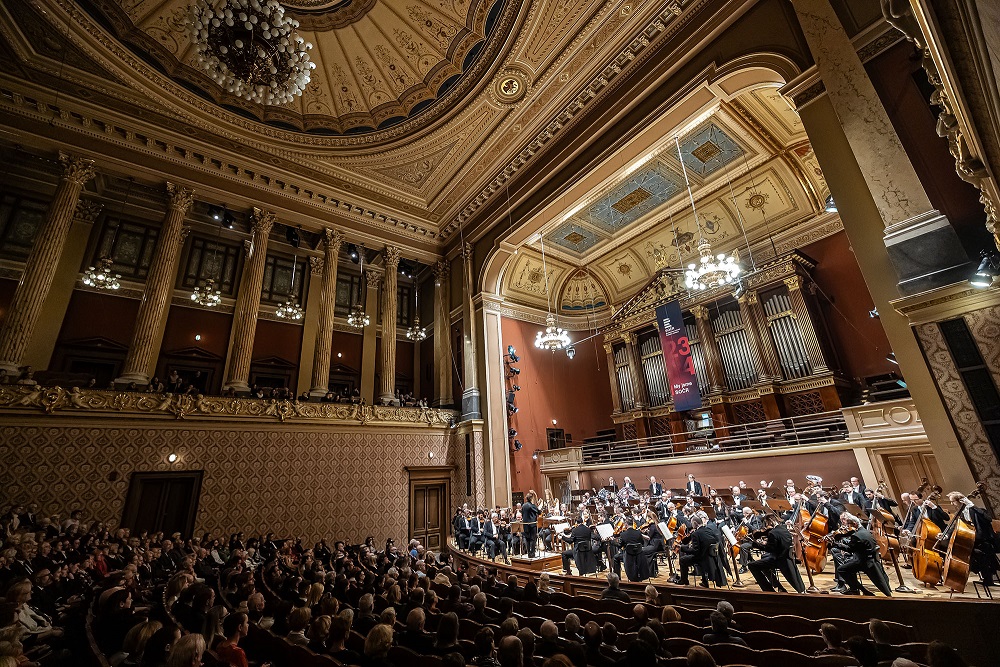
This year, the opening concert will be heard not only in the Smetana Hall at the Municipal House in Prague, but also on an international stage thanks to the Czech Centres network.
Where to watch:
• Vienna, Belgrade, London, Bratislava – live screenings in cinemas
• Tokyo – recorded screening in cinemas
• All Czech Centres – online on social media: Facebook Czech House Jerusalem
Join us for Smetana’s My Country on Tuesday, May 12, 2026, at 9 PM (8 PM CET).
Festival Prague Spring
Founded in 1946, the Prague Spring International Music Festival is one of Europe’s oldest and most prestigious classical music festivals. Held annually in May in Prague, the festival was established shortly after World War II with the ambition to reconnect Czech musical culture with the international artistic scene. Its opening concert traditionally features Bedřich Smetana’s iconic cycle Má vlast (My Country), which has become a symbolic hallmark of the festival.
Over the decades, Prague Spring has hosted some of the world’s most celebrated orchestras, conductors, and soloists, including Leonard Bernstein, Herbert von Karajan, Mstislav Rostropovich, and many others. Alongside its rich tradition, the festival continuously supports contemporary music, emerging talents, and innovative programming that connects classical music with new audiences.
Today, Prague Spring remains a vibrant international cultural event, attracting leading artists and thousands of visitors from around the world. Its combination of historical legacy, artistic excellence, and contemporary vision has secured its place among the most respected classical music festivals globally.
Programme Note
The origins of the conception of one of the most significant works by BEDŘICH SMETANA (1824–1884) – the cycle of six symphonic poems My Country – date back to November 1872, when the composer completed his fourth opera, Libuše. The mythical narrative culminating in the celebrated prophecy of the future glory of the Czech nation inspired Smetana’s fundamental idea of shaping a symphonic cycle as a tribute to his homeland, its people, its natural beauty, and its legendary past.
Although his vision developed gradually, the cornerstone of the work from the outset was the pair Vyšehrad and Vltava, whose scores were completed in the second half of 1874, at a time when Smetana’s prolonged health problems culminated in total deafness. Despite this tragedy, he worked with unusual speed: while Vyšehrad was composed between late September and mid-November, the completion of Vltava took him only nineteen days, as attested by a note at the end of the autograph manuscript.
Smetana resumed work at the beginning of the following year, first completing Šárka (February 1875) and then, in mid-October, the fourth part, From Bohemia’s Fields and Groves, in which – as we know from a letter to his friend Ludevít Procházka – he sought “to portray Czech life in song and dance”. At this point the cycle, provisionally bearing the title Fatherland (Vlasť), was set aside for a time.
During the next three years, the composer devoted himself intensively to other works of greater and smaller scope. Alongside the operas The Kiss (1875–76) and The Secret (1877–78), he revised The Two Widows (1877) and produced sketches for the later unrealised Viola (1875). After moving from Prague to Jabkenice in 1876, he composed his first string quartet From My Life and, through the cycle Dreams (1875) and the first series of Czech Dances (1877), returned to piano composition after a long interval.
He did not revisit the closed tetralogy until 1878–79, when he expanded it with two further parts, Tábor and Blaník, conceived as a celebration of Hussitism, one of the most powerful patriotic symbols of Smetana’s time.
Although each of the individual symphonic poems of My Country possesses its own distinctive musical logic and stands confidently on its own, the work’s uniqueness lies above all in the sophistication and inner cohesion of the cycle as a whole. Beyond the striking conceptual symmetry of the three pairs – mythological (Vyšehrad and Šárka), natural (Vltava and From Bohemia’s Fields and Groves), and martial (Tábor and Blaník) – its purely musical interconnectedness is particularly remarkable, achieved by Smetana through his ingenious handling of thematic recurrence.
At the close of Vltava, we hear once again the opening melody of Vyšehrad, whose two principal motifs return at the very climax of Blaník. In the final pair, Tábor and Blaník, it is Smetana’s inventive treatment of the Hussite chorale Ye Who Are Warriors of God that provides the shared thematic and motivic foundation, uniting the two symphonic poems into a single whole.
My Country entered concert life gradually, and the complete cycle was first performed on 5 November 1882 in the Žofín Hall under the baton of Adolf Čech. Smetana, who attended the premiere in person, later wrote to him:
“Sunday… the 5th of November was for me, for my great composition, a memorable day. It was as though I heard it piece by piece, inwardly almost in reality. I saw that the performance of those taking part, at the height of perfection, realised my dreams, and that you guided them… And what had dreamed within me, what had lived in my heart’s emotion, you all revealed by your mastery…”
In the years that followed, complete performances remained comparatively rare. Not least because the monumental and technically demanding cycle posed a challenge both for musicians and for audiences. This changed after the founding of the Czech Philharmonic in 1896: it first performed the work in 1901 and continued to return to it regularly, reinforcing – particularly in difficult wartime years – its status as a national symbol.
The concert of 5 June 1939, when a performance of My Country under Václav Talich became quite literally a national manifestation, remains legendary. Its inner spiritual strength proved no less potent after the liberation in 1945, amid the tense political climate of 1968, and again after the Revolution, when the returning exile Rafael Kubelík opened the Prague Spring Festival in 1990 with My Country, and in June of the same year conducted it to great acclaim before a packed Old Town Square.
Its message – that as a nation we have much to be proud of – endures in every age, including our own.
Hana Ehlová
English translation by Jan Rausch
Prague Radio Symphony Orchestra
Origins of the PRAGUE RADIO SYMPHONY ORCHESTRA date back all the way to 1923, when regular radio broadcasts were launched in Prague by a company called Radiojournal. Live broadcasts called for live music, and six players were soon hired to form what became the “core” of an ensemble supplemented by guest players as needed – especially from the ranks of the Czech Philharmonic. However, it soon became clear that this mode of functioning was insufficient, and the “Radiojournal Orchestra” began hiring additional full-time musicians. This also enabled the orchestra to give regular concerts at the Radio Palace in Prague’s Vinohrady quarter from 1925. In the present season, the orchestra celebrates the centenary of its founding.
In the 1930s, the orchestra became one of the leading Czech ensembles under the direction of Otakar Jeremiáš, and it was also conducted by other great personalities of that time including Sergei Prokofiev, George Szell, and many others. In the following decades, the orchestra changed its name several times and started performing abroad and also at the Prague Spring Festival from the 1960s (even opening the Festival under Alois Klíma in 1967). During its one hundred years of existence, many excellent Czech conductors have directed the orchestra, including Karel Ančerl, Václav Talich, Jaroslav Krombholc, and Vladimír Válek.
Due to its vital connection to the new medium – radio – the Prague Radio Symphony Orchestra played a unique role in the music life of the interwar period. It became a focus of progressive musical activity, with original compositions and even operas created for it, including Bohuslav Martinů’s radio operas Comedy on the Bridge or The Voice of the Forest.
Today, the Prague Radio Symphony Orchestra is one of the elite Czech orchestras. The Czech conductor Petr Popelka serves as its Chief Conductor and Artistic Director, with Robert Jindra as Principal Guest Conductor. In recent years the orchestra has collaborated with distinguished conductors including Omer Meir Wellber and Cornelius Meister, as well as Czech conductors Jakub Hrůša, Tomáš Netopil, and Petr Altrichter.
This season features collaborations with internationally renowned artists such as the violinist Christian Tetzlaff, the pianist Pierre-Laurent Aimard, and the bass Günther Groissböck. A regular part of the orchestra’s activities is the performance of works by contemporary Czech composers including Miroslav Srnka, Ondřej Adámek, Martin Smolka, Jana Vöröšová, Jan Ryant Dřízal, and many others.
Alongside countless radio recordings, the orchestra has produced numerous CDs, including a Smetana album of My Country (Supraphon, 2024), which received an Editor’s Choice distinction from Gramophone magazine and the Diapason d’Or ARTE award from the prestigious French magazine Diapason.
From the 2026/2027 season onwards, Elias Grandy will succeed Petr Popelka as Chief Conductor of the orchestra.
Prague Spring Festival