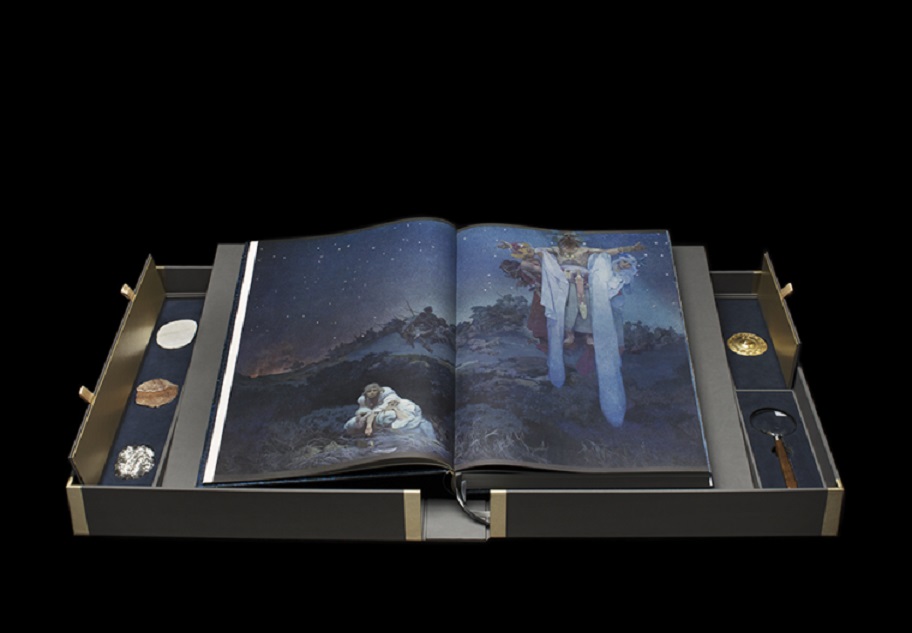
Exhibition: 'Behind the scenes - making of the book Epos' presents the creation and idea of the large-format picture publication “Epopej”. The exhibition is displayed in the Cinematheque Jerusalem daily from 17:00 till 22:00, free of charge.
About the book
The book is printed using a special technique. The printing grid is invisible not only to the naked eye, but even when using a magnifying glass, enlarging the image up to circa 6 times. The book depicts the Slav Epic canvases exactly as they may be viewed close-up in the gallery. This printing technology is almost never used in practice, mainly due to high costs and technological difficulty. “Although you cannot purchase the Slav Epic paintings, this book will allow you to see them better than you often could in a gallery,” says Jan William Drnek. The size of the book is 62 cm by 42 cm. There is a reason for these exact dimensions, because the size of an open page copies the commonly given size of the largest canvases of the Slav Epic – 610 cm x 810 cm. The book has 336 pages of mostly pictures. In a way, each of the 200 copies is an original, complemented by a jewel designed by Jarmila Mucha Plocková, Alphonse Mucha’s granddaughter, three symbolic stones from places of the Slav Epic’s stories, and a special magnifying glass for viewing. The book is hand-bound and is placed with the other artefacts in a special hand-made case. The whole set weighs 23 kg.
Slav Epic (20 works)
The Slav Epic (Slovanská epopej) is a series of twenty monumental canvases (the largest measuring over 6 by 8 metres) depicting the history of the Slav people and civilisation. Mucha conceived it as a monument for all the Slavonic peoples and he devoted the latter half of his artistic career to the realisation of this work.
The idea of the work was formed in 1899, while Mucha was working on the design for the interior of the Pavilion of Bosnia-Herzegovina, which had been commissioned by the Austro-Hungarian government for the Paris Exhibition of 1900. In preparation for the assignment he travelled widely through the Balkans, researching their history and customs as well as observing the lives of the Southern Slavs in the regions that had been annexed by Austria-Hungary two decades earlier. From this experience sprang the inspiration for a new project – the creation of ‘an epic for all the Slavonic peoples’ that would portray the ‘joys and sorrows’ of his own nation and those of all the other Slavs.
Between 1904 and 1909, Mucha visited the United States five times in hopes of finding a benefactor who would support his ambitious project and eventually, on Christmas Day 1909, he secured sponsorship from Charles Richard Crane (1858-1939), a wealthy Chicago-based businessman and philanthropist. Crane was intensely interested in the development of political affairs in Eastern Europe and Slavonic culture and he was to provide financial and emotional sustenance to Mucha for almost twenty years. Mucha returned to his homeland in 1910 to take up his mission.
Between 1911 and 1926 Mucha’s energy was taken up with the creation of the Slav Epic. For this project he rented a studio and an apartment in Zbiroh Castle in Western Bohemia to benefit from the spacious studio enabling him to work on enormous canvases. In the series, he depicted twenty key episodes from the Slavic past, ancient to modern, ten of which depict episodes from Czech history and ten on historical episodes from other Slavonic regions. The first canvas in the series, The Slavs in Their Original Homeland, was finished in 1912 and the entire series was completed in 1926 with the final canvas, The Apotheosis of the Slavs, which celebrates the triumphant victory of all the Slavs whose homelands in 1918 finally became their very own.
With the Slav Epic Mucha wished to unite all the Slavs through their common history and their mutual reverence for peace and learning and eventually to inspire them to work for humanity using their experience and virtue. In 1928, Mucha and Crane officially presented the complete series of the Slav Epic to the City of Prague as a gift to the nation, coinciding with the 10th Anniversary of its independence.
More about the book
Oficial website of the project